In a lush valley located in the eastern foothills of the Bismarck Mountain range of Papua New Guinea, the Ramu River rushes along, fed by five streams flowing down into the valley from the rugged peaks above. For many generations, tribal groups, including the primitive M people*, have made their home along the rocky banks of this river, and few outsiders have attempted the grueling task of reaching this nearly forgotten place. Tribal fights in years past drove the clans to this hidden valley, where they have lived in relative peace for many years.
On July 23rd, Jeremy, Alex, and Sam set out for a community nestled along the floor and sides of this valley. Their job was to scout the twelve villages that make up the community, determine if there is a church presence, and evaluate the beliefs of People M. What they saw and experienced made a distinct impression on them. What they learned has set the stage for the future of the Sanders family’s ministry in this country.
 |
| This is the view walking along the path towards the foothills of the Bismarck Mountain range. Our guide is in front with Pastor Able following. |
The only way to access this area is by walking for many hours along bush trails, traversing treacherous bridges, climbing mountains, and crossing a large, fast flowing river. There are no roads. As a matter of fact, there are no marked trails which lead to this territory on any maps. Because of the location of this community, on the border of two provinces, and the challenges of getting to the area, the M people have been largely left alone by government, business, and most of all, the national Christians. There are no schools, no hospitals, and no churches.
 |
| Alex is crossing the Ramu following Manesa, one of our national brothers. |
This valley sits at the crossroads of five language groups. The majority of the villagers can speak several of these languages, and a few can speak the uncatalogued, untranslated M language*. Many of the younger people can speak Tok Pisin, the trade language in PNG that we know, but the old folks cannot. During this trip, all of the conversations with the older members of the tribe came through translation into Tok Pisin by the younger people. Many of these discussions were crucial to our understanding of the local belief system.
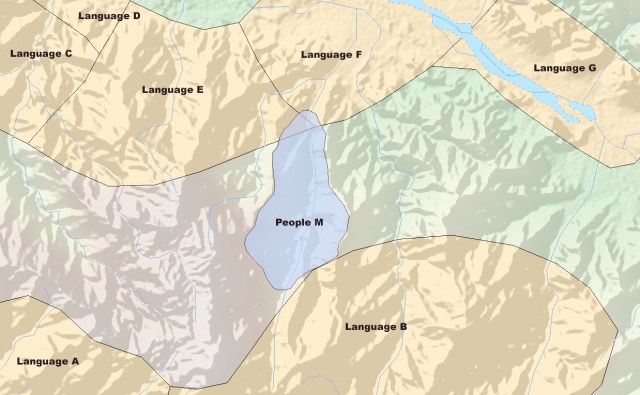 |
| The beige language groups are listed in the Ethnologue which catalogues all known languages. As far as we know, the tribal language of People M, has not been catalogued. |
In much of Papua New Guinea, history, myth, and religion are all wound together into one story, so it’s difficult to discern fact from fiction in some instances. The entire history of this area is oral, and anything that goes back more than three generations is shrouded in mystery and myth. One man told a story about World War II that was shocking in its inaccuracy, but the more shocking part was the sheer confidence with which the man told the story. He absolutely believes it to be true. Here’s the basic idea of the story:
During the war, one of my ancestors sacrificed a pig in the middle of the Japanese and American armies, and that ended World War II. After my ancestor brought peace to the land, Noah built an ark on that mountain over there and a big flood came.
Cargo cults are rampant in Papua New Guinea, and this group of villages is no exception. This particular cult began sometime around World War II and has continued until today. The entire worldview of the M people is entrenched in cargoism, even though they no longer officially meet for cult ceremonies. A helicopter pad still awaits the arrival of the goods that were “taken” from them in the “time before”. This worldview became very evident one night around the fire, when the most educated man in the area (he has a sixth grade education) asked the following question, which lead to an interesting conversation about local beliefs.
“Do you know where they took the snake?”
The guys of course had no idea what he was talking about, so they asked a few questions and heard the following story:
“A long time ago, a snake was found here in Papua New Guinea that had seven powers. They took the snake to the port. It was so big that the coils of the snake filled up twenty trucks. The snake was put onto a big boat and taken to America. Before it left, it gave three of its seven powers to Papua New Guinea, but it took the other four powers to America, and that’s how America became a super power. So tell me, do you know where in America the snake lives now?”
Each cargo cult has a story similar to this one. The general idea is that the only reason America and other countries have the ability to produce goods (“cargo”), is because something (in this case, a snake) was taken away from Papua New Guinea. The result is that Papua New Guinea has little to no development. The cargo cults want this “something” back so that they can get the goods.
The takeaway for us is that even the youngest, most educated generation of men believe the traditional tribal history on some level. They may not believe it as blindly as the older generation, but these stories underlie their hopes and dreams and the way they seek solutions to their physical and spiritual problems. This is the challenging environment to which we are being called with the hope of Christ.
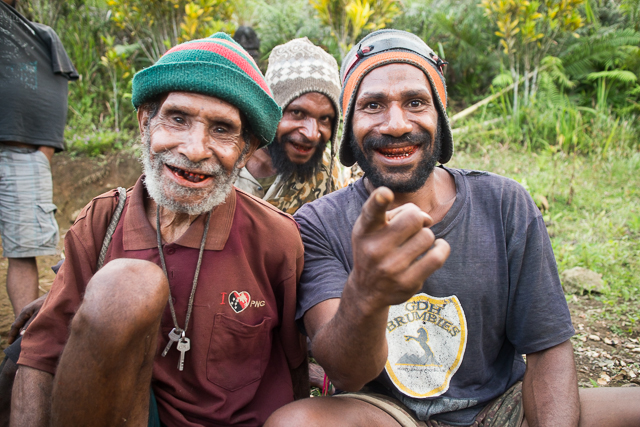 |
| The young man on the right, is the most educated in the area with a 6th grade education. The papa on the left told us much of the history of People M. |
A Conversation With a Pastor
During the last day of the trip, the pastor of a Lutheran church in the neighboring people group came to talk with Jeremy and Alex. He wanted to know the intentions of the white men. He was told that the missionaries just wanted to come and teach people about the Bible. The pastor asked if he could attend the teachings, then began to ask who God is, who Jesus is, and why Jesus came. This pastor knew the story of Creation, the flood story, Abraham and Isaac, and a few stories about David and Solomon. He knew about the birth of Christ, but didn’t know why Jesus came or why he had to die. He knew nothing of heaven or hell.
This man has been the pastor of the only “church” in walking distance for nineteen years, yet he doesn’t know the gospel.
The terrain of this country means that this valley isn’t the only area with this problem; many villages lie in hidden areas, a few with “churches” like this one, waiting to be reached with the gospel of Christ.
“How then will they call on him in whom they have not believed? And how are they to believe in him of whom they have never heard? And how are they to hear without someone preaching? And how are they to preach unless they are sent?”
When you look at a map of Papua New Guinea and see that 95% of the population is Christian, in reality many of these “Christians” are just like this Lutheran pastor. We’ve seen them with our own eyes, listened to their stories, and wept over their souls. We’re crying out to God that he would bring the gospel to this area, raise up leaders, and eventually plant a church among the M people group that will spread the gospel to the surrounding areas.
Thank you for your prayer support during this trip into the bush. Please continue to pray for the villagers, that God would open their hearts and prepare them for the gospel. Pray for the next trip into the area, which will be in October. Pray for wisdom as we seek the best way to minister to People M.
A few praises and prayer points:
- Praise God for a successful journey into the bush. His protection was evident during the trip, as the men were faced with plenty of challenges.
- Praise God for his protection of Kandy and the children during the week that Jeremy and Sam were gone.
- Praise God for the opportunities he’s given us to train Christians in our area.
- Pray for our family as we continue to discern our roles as teachers, disciple makers, and church planters in Papua New Guinea, and as we seek to continue the work despite the many challenges that come our way.
- Pray for our language abilities, which aren’t perfect yet since we’ve only been here for eight months. We want our communication to be as clear as possible in order to avoid confusion and to be able share the gospel with those who haven’t heard.
- Pray for our children as they are still undergoing constant, often very difficult transitions. As parents, we need wisdom to shepherd them well through these times.
- Pray for our marriage, and that we will cling to each other during challenging circumstances.
- Pray that we will rely only on Christ, the only Constant in our lives.
We don’t have space for all the stories from this trip. Perhaps we can catch up with you over coffee the next time we’re in town, and if you’re interested, share some more of the journey?
*In order to protect the privacy of the people group with which we are working, we have chosen to not mention their name or the name of their village in this public setting. They will simply be known on this blog as “People M” or “the M people.” Their language will be known as the “M language.” If you’d like to receive updates with this information directly to your email inbox, please subscribe to our mailing list.
Enjoy this 12 minute lighthearted look at our trip into the bush
//player.vimeo.com/video/105194021
We would love to hear from you. Feel free to email us with prayer requests, updates about your life, or anything else you’d like to send. Please drop us a note if you have time. We love getting personal email. You can email us at jeremy.sanders@toeverytribe.org or kandy.sanders@toeverytribe.org.
The Sanders Family
Jeremy, Kandy, Sam, Olivia, and Everett
If you’d like to partner with us financially,
click the below link and fill out the form:
Online giving link
Mailing Address:
PO Box 1383
Wheaton, IL 60187
To Every Tribe Finance Department:
(956) 233-4353, ext. 2010
If you have questions about our budget, partnership level, or any other finance related questions email us at jeremy.sanders@toeverytribe.org


 Sanders Party of Five